5/16/2014

From generalist to specialist


Before I started this course I had no idea how the game industry actually works. I was aware that there are people that are responsible for 2d work, 3d work, programming and producers.. But that was it. 

Only thanks to those Critical Studies tasks I started to research this subject more and I realized how big and complex game developing companies are. It was also interesting to learn how the industry has changed in last 25 years. Back then games were created by single or small group of people having some knowledge about coding. No artistic skills were needed whatsoever. As time went by technology has evolved. It created new possibilities by also new demands. When 3D technology has arose game developers were no longer limited to graphic build  from only a few pixels. They became able to show to the player fantastic creatures, fancy heroes and complex environments. However, someone has to design all of these first, and then build actual 3d models. Game artists were at high demand. 

Nowadays, when technology is even more advanced and games are more complex, most roles in the industry are increasingly specialized. For example, now you would find jobs like an environment artist, creature artist, vehicle artist, as well as texture artist and GUI artist. In the past it was all done by one person. 

As for me, I always knew what I want to do for living - draw monsters and robots. So, ever since I found out about existence of a job called Concept Artist it was clear to me that it's exactly the career path I want to pursue. Obviously, concept artist jobs do not consist drawing robots and monsters only. It requires to design things that don't exist yet. It's about imagining and that's what  I think I'm good at and what I like to do. 

Nevertheless, just like any other job, in gaming industry concept artist jobs have also became more and more specialized. I know artists who draw characters or vehicles only. There are also artists who draw monsters and robots only. So should I leave characters, environments and vehicles to focus on drawing monsters and robots to be more specialized and in that area, so that then I could try to become, for example a creature artist? Well, following Feng Zhu advice - no, I shouldn't.


In his video tutorials series called Design Cinema, he said many times that it's very unlikely for someone who is new to the industry to find job as a specialist. Moreover, he stressed it that being a specialist doesn't mean that you can draw only one subject. It means that you are good at drawing everything and you are excellent in drawing particular subject . If company would hire me as  a concept artist and asked me to draw concepts for a heroe's vehicle I couldn't just say ''Oh, sorry I draw monsters and robots only''. In that scenario the employer would get rid of me straight away, because they could hire in my place someone who can draw everything. 

So, to sum this up, if you want to become a specialist, better start as a generalist. That way you can do more things = you are more useful.   

5/07/2014

Interaction design


Some people, particularly non-gamers may think that interaction with games is something new and that it wasn't possible before we had Wii, Kinect and Move. They may think that before we could play games only with gamepads and joysticks or mouse and keyboard in case of computers. Well, they are wrong.

I remember that even when I was a child there were some additional controllers available that you could use to play video games. Personally I only owned one, which was a gun that I used to shoot ducks in the game called Duck Hunt.


I remember it quite well because it was  the only video game that I could persuade any family member to play with me. Why was that? Why this game and not any other? Thanks to this controller. It was really fun and it allowed to interact with game in interesting way. Also it was very intuitive. When you grabbed this controller you instantly knew how to play this game. You didn't need to learn which button does what, you only had to aim and push the trigger! simple as that, even my grandparents played it. I believe that if they were younger now they would enjoy playing kinect games too. 

Because that's the main feature of games with additional controllers: they are simple and intuitive. I love the possibilities that motion sensors like Kinect, Move and Wii gives to the player. Now you're not bound to the couch, you can actively play tennis, football, learn how to dance and even destroy armies of robots as a Jedi Knight.


That said, my favourite interactive device is not used for playing games. For me, as an artist, graphic tablets are one of the mankind greatest inventions (along with computer that you plug this tablet into). Even in 1000 years I would not be able to draw picture like this with just a mouse.


Actually, sometimes I even use my tablet for playing games. It's extra handy when I play Pictionary online.

As a last thing I only say that it's really interesting to see how technology evolves and I'm looking forward to see how gaming is going to look in the future.  

Sound in games


Sound is one of a game aspects that has the biggest influence on how the game is received. It creates mood and helps the player to better understand the situation he is in. For example, when you play any RPG game and you're in danger, surrounded by deadly monsters the music you will hear is going to be different from what you would hear while safely resting in a tavern, drinking beer in front of a fireplace. 

Speaking of which, here's an anecdote from my life: Baldur's Gate 2 is my all time favourite game and from time to time I feel a strong urge to install it again and play it for at least few hours. So it happened about a month ago. Unfortunately, due to massive uni workload related to the group project, I had no time to spare at all. So, I decided to at least listen to the soundtrack while I was working on the project. And I did. About seven times, whole 53minutes from beginning to the end. It's just so good! It recalled many great memories and made my work more enjoyable. 


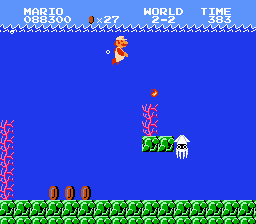
I guess it shows how important part of game is music. And it doesn't have to be sublime, orchestral music like in Baldur's Gate. Actually, I think that simple 8/16 bit music in older games was catchier and more memorable. I bet that when you look at each of these tree pictures below you have different melody in your head :)


But music is only one part of sounds used in every game. There are also weapon sounds, environment sounds, vehicle sounds etc. 

I remember that as a 9 year old I played the original Half-Life a lot. I know I shouldn't have, but I guess it had a big impact on my imagination. And come on, it wasn't much worse from Alien movie that I watch as a 8 year old. Anyway, about 10 years  later a friend of mine introduced me to Team Fortress 2. I instantly recognized the switching weapon sound as the one that was also used in Half-Life! It was not important, half a second long sound but I wouldn't mistaken it with anything else!

 Coming back to Team Fortress 2, there's another type of sound in games worth mentioning: characters sound. Medic without his German accent wouldn't be the same character, just like Pyro would be completely different without his 'MMPH!'. Voices are the quality that makes those characters so funny and unique. 

Can you imagine GLADOS from Portal game without her voice? If you mute her she is just few robotic balls and wires hanging down from the ceiling!

I just realized that most of the games I mentioned above (Half-Life, TF2, Portal) were developed by the same studio - Valve, so I guess that means they pay attention to sound in their games. My Favourite score music also comes from Portal:


 I hope that this entry helps to show the importance of sound in video games.        

4/28/2014

Game Engines


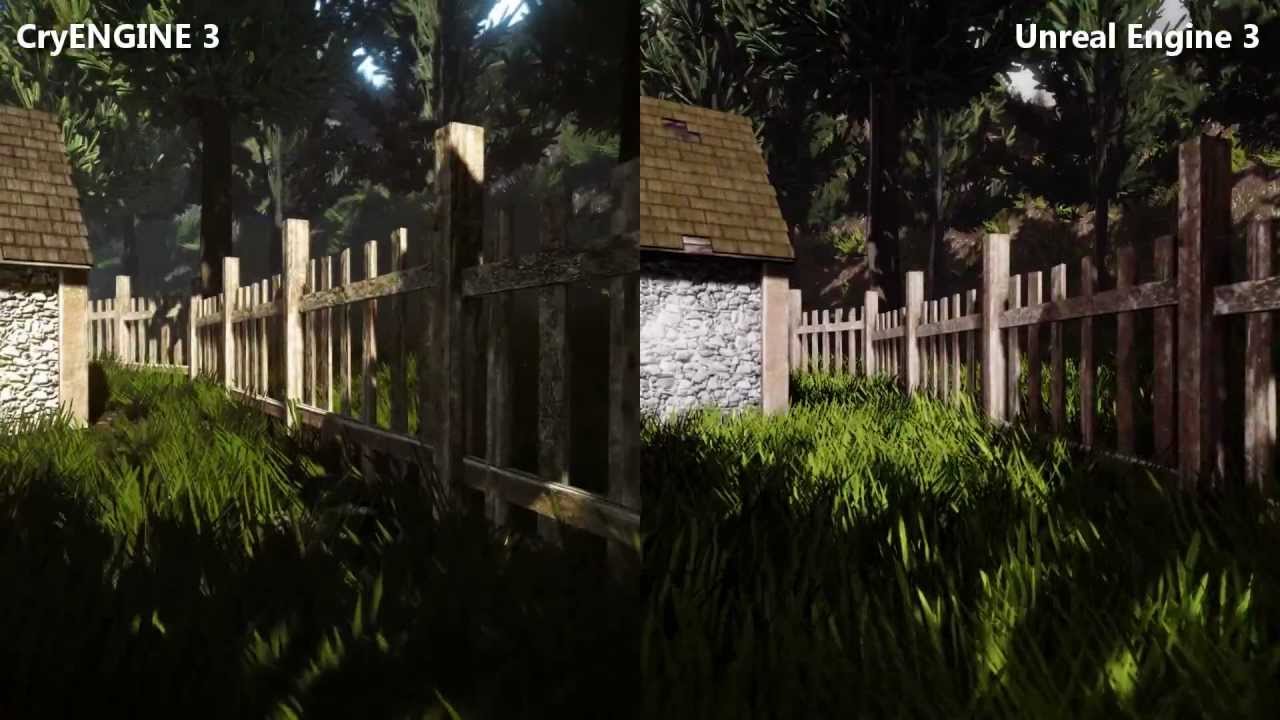
So game engines... The subject that I don't have too much to say about. Obviously as a part of this course I had the opportunity to work a bit with UDK and Cryengine but unfortunately my experience covers only importing and placing assets. I'll have to work on it over the summer, so I won't waste time on learning the engine basics in the third year. So due to my lack of first-hand knowledge I did a bit of a research and in this post I'll not relate to my own experience too much, but I'll rather rely on information I found on the internet. I'll focus on three leading game engines (UDK, Cryengine and Unity) and  talk a bit about their history and in which games they were used.

But first a few words about game engines in general. What is a game engine? It's a virtual place where game developers put their individual works so they compose into the whole - game. It includes all assets, textures, music, animations, UI, scripts etc. So in a way game engine is like a glue that holds all these elements together. Some companies use already existing engines whereas others create new engines for their games specifically. 

The first engine that I'll talk about is called Unreal Engine. It was developed by American game developed Epic Games and first used in 1998 in game called (surprise, surprise) Unreal. It's core has been written in C++ so it can be used on many different platforms including Windows, iOS, Mac, Xbox and Playstation. That may be one of the main reasons why it's so eagerly used by many game developers. It's been usually used for FPP, MMORPG and RPG games such as Gears of War, Mass Effect, Bioshock, Borderlands, Deus Ex to name just a few. 
 
As I mentioned before I had the opportunity to work with Unreal Development Kit, but unfortunately we haven't become friends. In my opinion it has really ugly and vague interface and when I wanted to explore it, it kept crushing. It happened so many times that now I'm literary afraid to click anything in it.


Anyway, the next engine that I also worked with was CryEngine. It was designed by German game developer Crytek, the first game it was used in was Far Cry and it's probably mostly known from Crysis series (cry, cry, cry!). Games created in CryEngine look visually stunning, the lighting is just amazing and outdoor environments look realistic. I have to admit that so far my work with this engine was problem-less, the interface is user friendly and it only crashed twice (well, nobody's perfect).


The last engine that I'll talk about is Unity. Although I never worked with it I have heard quite a lot about it so I decided to mention it as well. It's a quite young engine (2005) by Unity Technologies, that is mostly used by independent and mobile games. I guess that one of the biggest pros of this engine is that it allows in-browser gaming with minimal downloads required.

Obviously these are only few of the existing game engines, all of them have pros and cons, but it's interesting to see how they vary and what they are capable of.    

Links:

Documentation


Documentation. My worst enemy. I've been struggling with it since the first year. I've never got into the habit of writing my design documents along the way of creating actual assets, so I usually have to do it the night before hand-in... And it's really hard to recall and properly describe a month's worth of work in one night.

Although, even that I hate it so much I understand the importance of documentation and why we've been doing it as a part of our course. It's essential in process of game creation. If company hires hundreds of workers it's easy to lose track of who is doing what and whether they are doing it correctly -  so here's where design document comes in handy. 

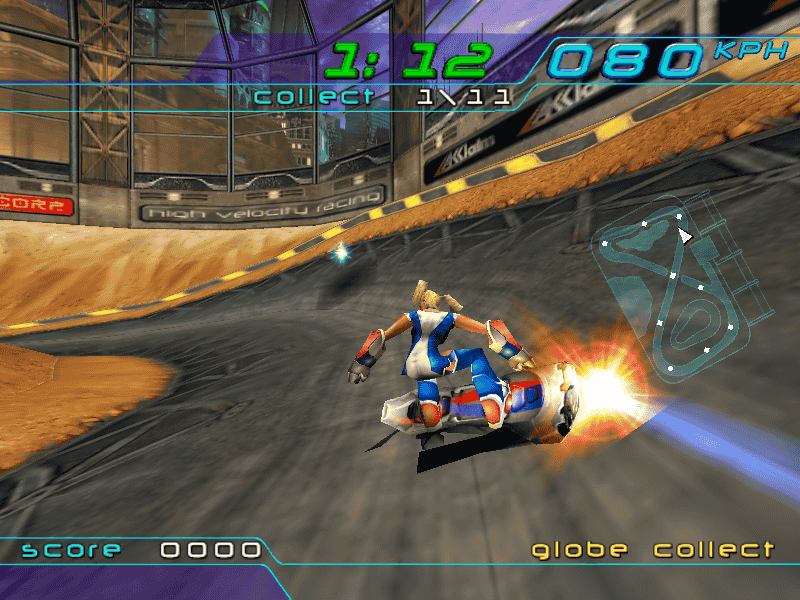
Here I'm going to make up a game as a practice for my Final Major Project for my third year. Actually it's going to be based on a game that I played as a kid, but I can't recall its title now. I've never been a fan of racing games but I really enjoyed that particular one and I wish someone would do a remake of it.  

Audience: 15+


Genre: sport/racing


Platform: Xbox 360/ PS3


Overview: 

Futuristic, slightly cartoony (similar to Borderlands) hover-board racing game. The main character is a teenager who built his/her own hover-board from scratch and takes part in illegal, amateur midnight races (tutorial part of the game). He/she is really good so he/she gets a chance to take a part in real tournament (main part of the game). The competition is dirty and dangerous, there's only one rule - whoever is the first on the finish line wins the race. The hover-boards are highly customisable and there're also many weapons to be used. 


Lead Character:

customisable, player can chose gender and face characteristics, but it's always a teenager from a lower class family (to support the story)
Outfits and hairstyles can be changed and tattoos and accessories can be added along the way between the stages of tournament. These additions can be purchased for points that player earn by winning races.
 About 8,000 tris


 NPC:


Varity of opponents from different social classes (can be distinguished by outfits and hover-boards advance level)

different kinds of enemies with different race styles:

  • Tall, slim enemies that prioritize speed
  • Big and heavy enemies that trying to knock the player down
  • Small enemies that mainly use weapons and traps to eliminate others.

5,000-6,000 tris each


Vehicles:

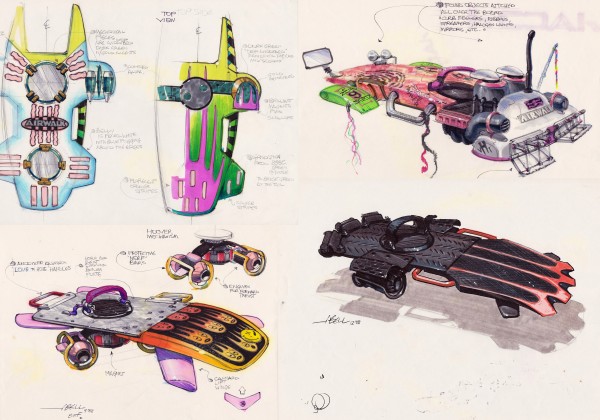
hover-boards reflect personalities and race styles of their owners.
Player can customise their own by spending points gained on winning races.


Environments:

tutorial part of the game: futuristic but dirty slums areas
main part of the game: variety of racing tracks. Some wild and rough environments like deserts, ice fields, jungles as well as futuristic, technologically advanced racing arenas with holographic billboards and screens.
Many ramps and shortcuts to be discovered by player. 


Props:

Plenty of weapons to choose from like bombs, rockets and traps like force fields.